
I. Overview: A Quiet Change with Broad Consequences
A provision inserted into the Senate-amended One Big Beautiful Bill Act quietly alters a long-standing element of the U.S. tax code: the treatment of gambling losses. If left unaddressed, the change will take effect on January 1, 2026, reducing the permissible deduction of gambling losses from 100% to 90%.
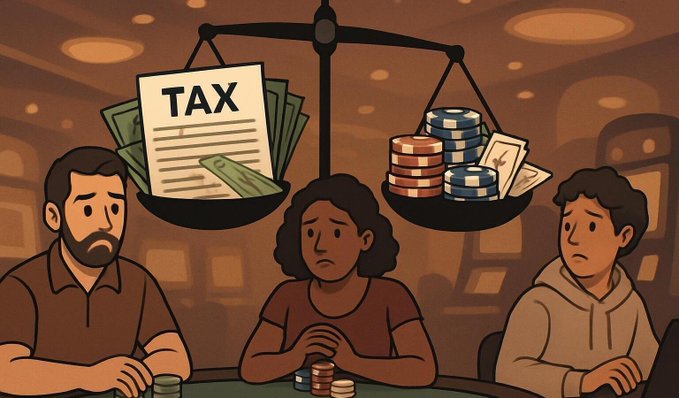
While the adjustment may appear minor on paper, its real-world impact is significant. By taxing 10% of losses as if they were income, the provision creates what lawmakers and industry stakeholders have described as a “phantom tax”—tax liability on money never actually earned.
Multiple members of Congress from both parties have since introduced legislation aimed at restoring the historical standard. This article outlines the issue, the legislative responses currently on the table, the procedural roadblock that now determines whether a fix can occur in time, and the industry leaders endorsing the legislation.
II. The Origin of the Phantom Tax: Senator Mike Crapo and the One Big Beautiful Bill
The reduction of the gambling loss deduction from 100% to 90% originated in a Senate-amended version of the One Big Beautiful Bill Act. The provision is associated with Senator Mike Crapo (R-ID), though it received limited public attention during the bill’s advancement.
Under Representative Crapo’s revised rule, taxpayers would be permitted to deduct only 90% of their gambling losses against winnings, even if those losses fully offset gains. The remaining 10% would be treated as taxable income.
If implemented, the policy would apply broadly to:
– Casual recreational gamblers
– Professional gamblers
– Sports bettors
– Poker players
– Horseplayers
– Table game enthusiasts
The change does not distinguish between profitability and loss over the course of a tax year.
Railbird Creations reached out to Senator Mike Crapo’s office. There has been no comment as of the time of this publication, but we will update the piece if Senator Crapo responds to our request.
III. The FAIR Bet Act: Representative Dina Titus’s Legislative Response
On July 7, 2025, Representative Dina Titus (D-NV) introduced the Fair Accounting for Income Realized from Betting Earnings Taxation (FAIR Bet) Act. The bill proposes a narrowly tailored fix: restoring the gambling loss deduction to 100%, returning the tax code to its historical standard.
As of December 11, 2025, the FAIR Bet Act has 21 bipartisan cosponsors, reflecting support from lawmakers representing both established gaming jurisdictions and newer markets. The legislation also enjoys broad industry support, including the American Gaming Association, MGM, DraftKings, FanDuel, Caesars, Wynn, the Nevada Resort Association, and the National Thoroughbred Racing Association.
Representative Titus has emphasized that the bill does not expand or restructure the tax code—it simply corrects a deviation that would otherwise tax non-existent income.
IV. H.R. 4630 (The WAGER Act): Representative Andy Barr and the Horse Racing Industry
A parallel effort emerged on July 23, 2025, when Representative Andy Barr (R-KY) introduced H.R. 4630, also known as the Winnings and Gains Expense Restoration (WAGER) Act of 2025.
The WAGER Act mirrors the core objective of the FAIR Bet Act: restoring full, 100% deductibility of gambling losses before January 1, 2026.
Representative Barr is a prominent advocate for the horse racing industry, serving as the Co-chair of the bipartisan Congressional Horse Caucus. He has also sponsored multiple bills addressing racing safety, integrity, and economic sustainability of the racing industry.
While H.R. 4630 currently has a smaller number of cosponsors, it has received formal endorsements from major horse racing organizations, including:
– U.S. Trotting Association (USTA)
– National Thoroughbred Racing Association (NTRA)
– Keeneland
– Breeders’ Cup
– Kentucky Thoroughbred Association
Industry leaders have emphasized that wagering activity is foundational to purses, employment, and racetrack viability nationwide. For example, USTA Executive Vice President and CEO Mike Tanner shared that, “The WAGER Act delivers meaningful tax fairness for horseplayers and strengthens the wagering environment that our sport depends on,” said Tanner. “By restoring the full deduction for wagering losses, this legislation supports everyday bettors, protects handle, and helps ensure that pari-mutuel wagering remains competitive in a rapidly evolving gambling market.”
V. The Procedural Bottleneck: Why the Ways and Means Committee Matters
Despite bipartisan sponsorship and industry backing, neither the FAIR Bet Act nor H.R. 4630 can advance without a hearing before the House Ways and Means Committee.
That authority rests solely with Representative Jason Smith (R-MO), Chair of the committee. Without a scheduled hearing, neither bill can move forward for debate or a vote.
Representative Titus formally requested committee consideration in a letter (which you can see here) urging timely action, citing both taxpayer fairness and the risk of unintended economic consequences.
VI. Casino Executives Enter the Conversation
On December 11, 2025, Derek Stevens, CEO of Circa and co-founder of the D Las Vegas, shared a video on Twitter/X confirming that he and several major casino executives met with Representative Dina Titus and Representative Jason Smith to discuss the FAIR Bet Act.
According to Mr. Stevens, the meeting included:
– Bill Hornbuckle, CEO, MGM Resorts
– Craig Billings, CEO, Wynn Resorts
– Tom Reeg, CEO, Caesars Entertainment
– Bill Miller, President & CEO, American Gaming Association
The meeting underscores the growing alignment between lawmakers, gaming operators, and industry groups around the need for a legislative fix. As Mr. Stevens shared on Twitter/X in a video he shared (which you can see here), passing the bipartisan FAIR Bet Act “should not be hard when everyone’s in agreement.”
VII. What Happens If No Hearing Occurs
Absent a hearing and subsequent legislative action, the 90% deduction limit will take effect on January 1, 2026.
The consequences extend beyond gambling activity itself. Because taxable income is used to determine eligibility for public benefits, affected individuals could face:
– Artificially inflated income levels
– Loss of Affordable Care Act (commonly referred to as Obamacare) healthcare eligibility
– Loss of the Child Tax Credit (CTC), a non-refundable tax credit
– Unexpected tax liabilities despite net losses
These outcomes would impact not only professional gamblers, but also recreational players and families whose income fluctuates year to year.
VIII. Conclusion: A Narrow Fix with a Short Clock
At present, there is bipartisan agreement on the nature of the problem and multiple legislative vehicles designed to address it. The remaining obstacle is procedural rather than ideological.
Without a hearing in the House Ways and Means Committee, neither the FAIR Bet Act nor the WAGER Act can advance. Without passage, the phantom tax becomes law.
As January 1, 2026 approaches, the question is no longer whether Congress understands the issue—but whether it will act in time to prevent a tax on income that never existed.
Disclaimer: This article is for informational and advocacy purposes only and represents our best interpretation of current and proposed U.S. tax laws as of December 2025. It is not intended to provide, and should not be relied upon as, professional tax, legal, or financial advice. Tax rules are complex and subject to change. Readers are strongly encouraged to consult a qualified tax professional or attorney for advice specific to their individual circumstances.